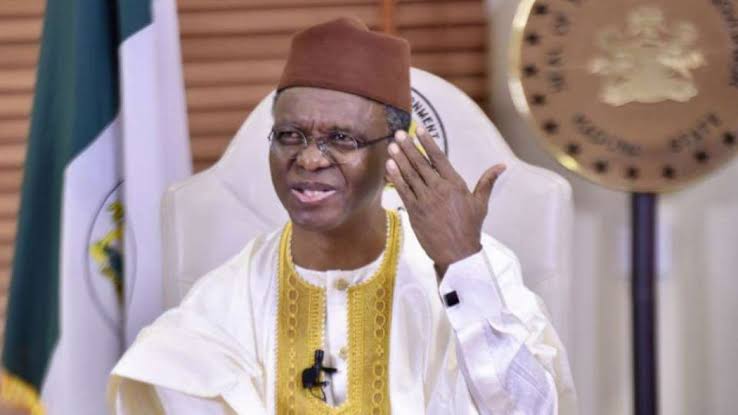
Kaduna State Governor, Nasir El-Rufai, de-emphasized political zoning arrangement in Nigeria.
Kaduna State Governor Nasir El-Rufai has made a case for the abandonment of zoning arrangements for political offices as currently obtainable in the country.
He said the arrangements needed to be de-emphasised and ultimately abandoned in favour of competence.
Some key political offices at the federal and state levels, particularly governorship and Presidency, are rotated among the various ethnic groups or zones.
Although an informal arrangement, the position of the President currently rotates between the North and the South.
With President Muhammadu Buhari from the North serving his second and his last term as allowed by the constitution, there are already talks about the South producing the next President in 2023.
But El-Rufai said Nigeria could not afford to continue on the same path of zoning positions based on regions of origin.
The governor made his position known in a prologue titled, ‘Defeating a Determined Incumbent – The Nigerian Experience’, which he contributed to a book –Power of Possibilities and Politics of Change in Nigeria – written by the Director-General of the Progressives Governors’ Forum, Salihu Lukman.
He described the zoning of political offices as a barrier to political equality.
The governor, who highlighted the factors he said contributed to electoral success of the All Progressives Congress in the 2015 presidential election, also proposed a new funding model for parties as a major way of curtailing the excesses of political godfathers.
He argued that the present method of funding parties was “opaque”.
He said, “Even with our success in the 2015 elections, there is room for improvement. Barriers to political equality, such as our seemingly entrenched though informal rule for zoning candidacies according to regions of origin, need to be de-emphasised and ultimately abandoned in favour of an emphasis on qualification, competence and character
The financing of parties, candidates and campaigns remains opaque